Lasting impact
Celebrating Bangor’s first surveyor Park Holland, whose work still impacts land transactions today
By Stephanie Bouchard
When the Bangor Historical Society reopens in May, it will unveil a new exhibit marking the nation’s 250th anniversary.
Among the memorabilia are items belonging to a Revolutionary War soldier who took part in some of the conflict’s most significant operations and whose contributions to Bangor are still evident today.
Park Holland was 23 years old when in the fall of 1776, he left his home in Petersham, Mass., and took part in the military actions known as the battles of Long Island, Harlem Heights, and White Plains.
An officer of the 5th Massachusetts Regiment, Holland would later take part in the Battles of Saratoga and witness the British surrender there. He helped build Fort Putnam at West Point, telling his nephew in a letter written in 1832, “Your father and myself both then being subaltern officers, with fifty men struck the first stroke towards building this fort.” And he was present for the construction and placing of the ingenious iron chain across the Hudson to block British ships.
He was stationed at White Plains, N.Y., when the British surrendered at Yorktown, Va., effectively ending the war.
“The consequences,” he wrote to his nephew, “are known to every American, but very few can now realize the joy and gratitude which that event caused every heart to feel.”
Holland’s intersection with significant historical events of our country’s founding didn’t end with his Revolutionary War service. Back home in Petersham, Mass., he was chosen to be the captain of the local militia, and when Daniel Shays and his Regulators ended their “rebellion” in Petersham, he was on hand for the surrender.
But it was the relationships Holland formed during his war service that would shape the rest of his life. In the years immediately after the Revolution, they led him to a new line of work that would leave a lasting mark on the city of Bangor.
That work was surveying. His first surveying foray into Maine was in 1783, when he joined his former regimental commander to survey the area around the St. Croix River and Passamaquoddy Bay. In the years that followed, he surveyed a number of other locations in Maine, but it was his survey of the settlers’ lots in Bangor in 1797 that earned him the moniker of “Bangor’s first surveyor.”
His survey of the lots of the city’s first settlers form the basis of Bangor’s land records and still impact land transactions and legal descriptions today.
“If you own old property in Bangor,” said Matt Bishop, Bangor Historical Society’s curator and operations manager, “a lot of them are still kind of using his same original survey.”
Holland’s survey of Bangor influenced the placement of streets and the overall design of the city, Bishop said. Without Holland’s survey, he said, “the city might not be laid out the same… Bangor might look a little bit different.”
Holland also surveyed many communities in the area, including in and around Orono and Hampden, so his impact across the region is wide-ranging, Bishop said.
“He definitely did leave a lasting legacy.”
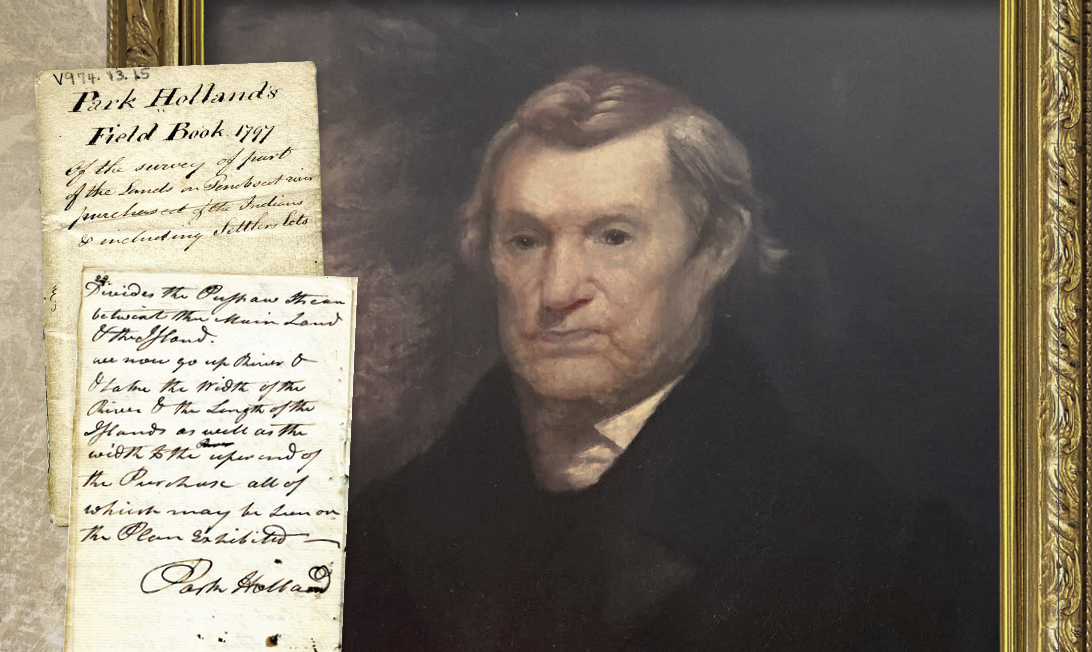
Holland’s survey map of Bangor and a portrait painted of him a handful of years before his death in 1844 will be on display as part of the historical society’s exhibit opening, Bishop said.
The Bangor Public Library also has some Park Holland materials, including his 1797 field book, which can be accessed by the public by going to the library’s local history and special collections section. The field book is also available for viewing online by going to digicom.bpl.lib.me.us.
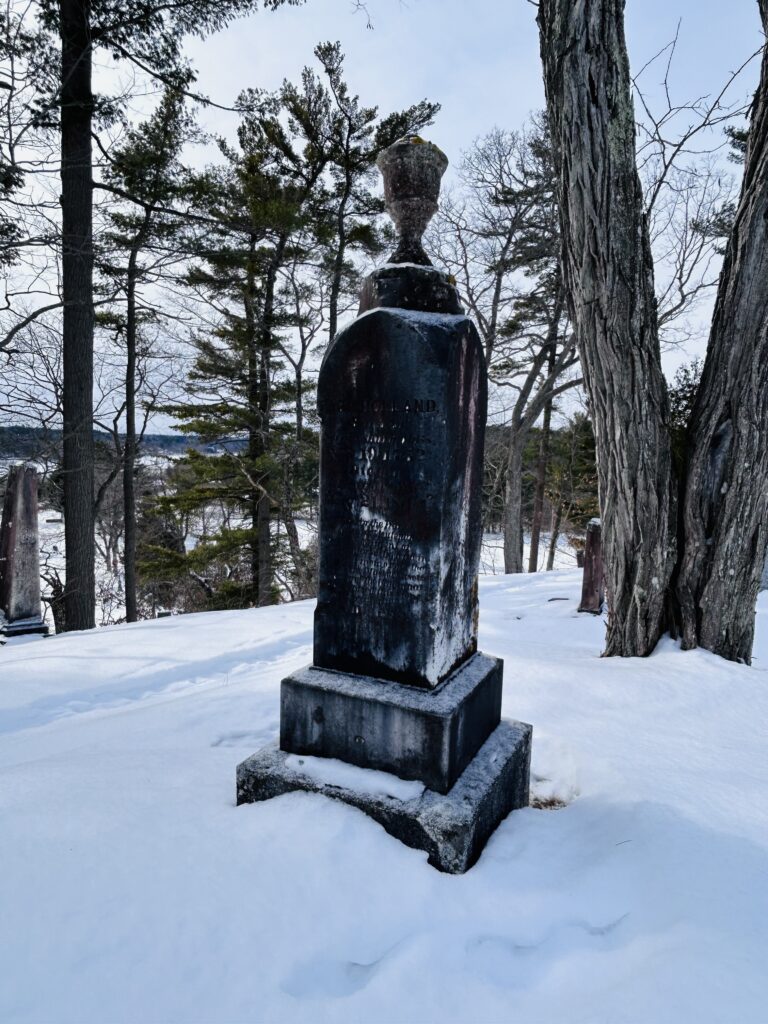
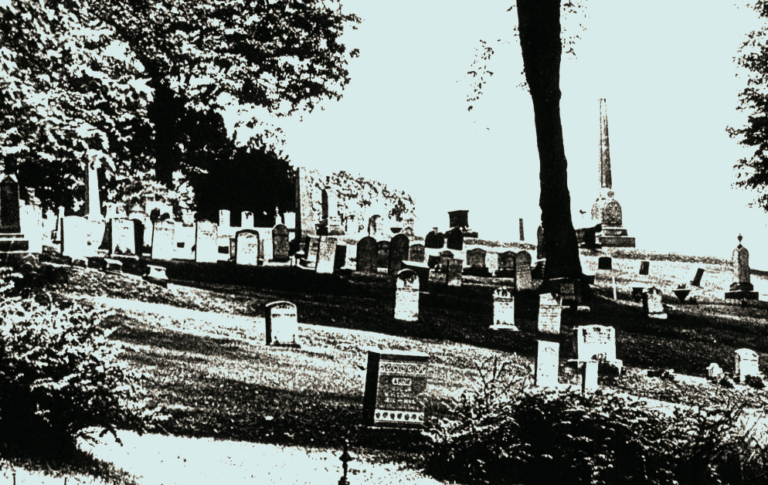
Park Holland is buried near the bell tower in Bangor’s Mount Hope Cemetery, a location he surveyed. In 1888, the Massachusetts Society of the Cincinnati, an organization formed by commissioned officers who served in the Continental Army or Navy during the Revolutionary War, placed a memorial stone at his gravesite. Descendants of those officers, including Holland’s, are members of that society to this day.
Learn more at bangorhistoricalsociety.org.
Top image: Pages from Holland’s 1797 Field Book. “Park Holland’s Field Book 1797” is courtesy of the Bangor Public Library. Available for viewing at digicom.bpl.lib.me.us/books_pubs/4.