Britain’s Mark on Maine
After America Won Independence, Maine British Place Names Remained
By Richard Shaw
Drive around Maine today and you might think the British never surrendered control of the 13 original colonies in 1783 with the Treaty of Paris.
Five of our 16 counties — Cumberland, Oxford, Somerset, York, and Lincoln — were inspired by U.K. locations, as were numerous mountains, lakes, and avenues.
Apparently these names were so well known by the American Revolution’s end that most of them remained on pre-GPS maps and signs. In Bangor alone, which sent soldiers off in the seven-year conflict, several streets bear British-inspired Maine county names, in addition to Essex, a ceremonial east England county.
The state’s two other largest cities, Portland and Lewiston, also share British street names. Included are Avon, Berkeley, Epping, and Nottingham. The list may grow as subdivisions are added with lanes and cul-de-sacs that bear exotic foreign names. Apparently all is forgiven from a war that claimed an estimated 25,000 patriots, some from the frontier of Maine.
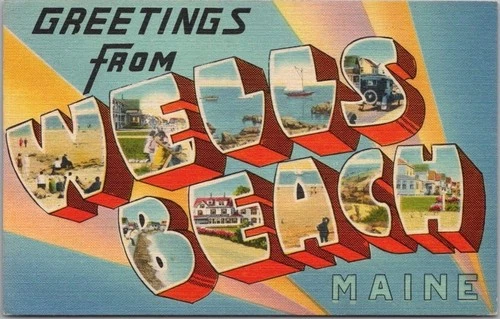
“… Many of Maine’s earliest towns (such as our first three towns, Kittery — named after a manor in Devon in southern England — and York and Wells) are named for places in England,” explained Nora Flaherty in a 2015 Maine Public commentary. “Yet other towns — such as Leeds in Androscoggin County — are named after English cities and towns in honor of people the settlers knew…”
“Sadly, we don’t know — or at least we don’t know for sure — the reasons why several Maine towns and cities were named after the foreign places they were,” Flaherty continued, citing Ava Harriet Chadbourne’s book “Maine Place Names and the Peopling of its Towns” as her source. “These include a lot of English town names (such as Acton, Argyle, Guilford, Falmouth, Newcastle, and Portland)…”
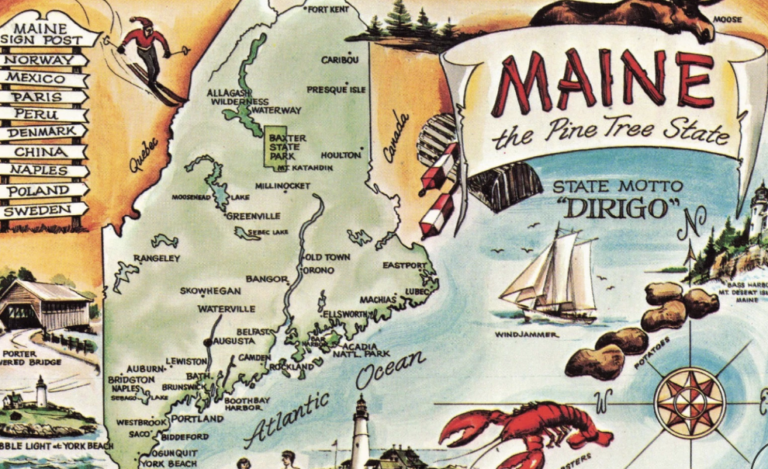
The list is seemingly endless, but notably, no British name appears on the much-parodied international sign post in Lynchville, erected in the 1930s to boost tourism, while such Maine places as Mexico, Peru, China, and Denmark stand out among the nine that do.
Many historians would probably name the following places as among the state’s leading British-inspired locales. It is no coincidence that all are located in midcoast and southern Maine, the first regions to be settled by Europeans.
BATH
Home to Bath Iron Works and the Maine Marine Museum, this Sagadahoc County community of more than 8,800 was settled as a town in 1781 and as a city in 1847. Its British sister city, Bath, Somerset, population 94,000, is famous for its Roman baths.
NEWCASTLE
Incorporated as a town in 1775, this Lincoln County town of more than 1,800 was settled in the 1630s by fishermen and about 50 families. Its most famous native daughter, FDR Cabinet member Frances Perkins, was honored in 2024 when her ancestral home here was named a national monument.
BRISTOL
Wikipedia describes this town of more than 2,800 as a fishing and resort area. Included in its archaeologically rich boundaries are New Harbor, Pemaquid, Round Pond, Bristol Mills, and Chamberlain, all located in Lincoln County.
YARMOUTH
This Cumberland County town of nearly 9,000 was incorporated in 1849. It is home to North Yarmouth Academy and 12 properties listed on the National Register of Historic Places. Cousins Island and its proximity to Freeport and Portland are among its selling points.
SCARBOROUGH
Just south of Portland lies Maine’s most populous town, listed in the 2020 census as having a population of more than 22,000. Settled in 1635, incorporated in 1658, its history dates to the 1675 King Philip’s War. The former Scarborough Downs Race Track has been converted to a multi-use facility.