Imperfect Heroes
Historical Fiction Asks Timeless Questions
By Robin Clifford Wood
“The Seraph,” Jane Goodrich’s second novel immersed in late 19th century history, was released in July 2026. When we met in Southwest Harbor before her book event, Goodrich shared a story about her earliest authorial output.
“I vividly remember running to the lawn chair where my mother was sitting outside. ‘Read my story!’ I said. ‘But you can’t read yet, dear,’ said my mother.”
Little Jane was still too young to read and write, but she’d made a bunch of random marks on paper that she “read” to her mother, word for word. Clearly the inclination to tell stories was born early in Jane Goodrich.
Running alongside Goodrich’s love of reading and writing was her early love of history.
“When I was 7 or eight 8 old, my grandfather took me to an auction. Everything was 19th century, and I thought it was all fabulous,” she said. “He gave me a blue glass insulator. It was my first antique.”
That was the beginning of a lifetime love of historic artifacts. Goodrich’s particular interests lie in the historic period between about 1870 and 1930. Both of her novels — which she wrote by hand with the same fountain pen — delve into lives from that period.
Arguably Goodrich’s most ambitious project was unrelated to writing, though it led to her first novel. “The House at Lobster Cove” is based on the story of an extraordinary late 19th century home called Kragsyde. After seeing a photograph of the old house, Goodrich was entranced. Years later, dismayed to learn that Kragsyde had been torn down, Goodrich and her fiancé tracked down blueprints to the house. In a span of 15 years, the two of them — a master builder and a design specialist — built a reproduction of Kragsyde on Swan’s Island in Maine.
“I drove the backhoe, I laid the blasting caps…I did everything,” Goodrich said.
During those 15 years, Goodrich became intrigued by the house’s original owner, George Nixon Black, whose philanthropic contributions were legendary and whose life was shrouded in secrecy. Black’s story, and Kragsyde, lit the flame of curiosity for Goodrich, who spent years researching and writing “The House at Lobster Cove.”
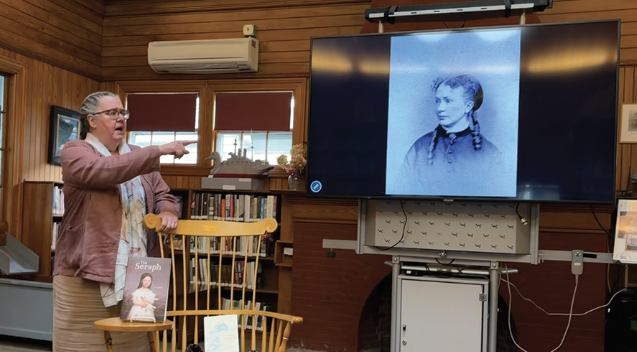
In “The Seraph,” Goodrich puts her meticulous historical research into play again as she imagines details into the real life of Cora Page, a renowned 19th century spiritualist medium. At a time in history when women’s voices were rarely acknowledged, Page’s voice was heard by thousands who flocked to hear her speak in the words of “ghosts” from the past in meditative trances on stage. “The Seraph” explores the shadowy boundaries between fraud and authenticity, fact and speculation, right and wrong — concepts we continue to grapple with every day, 150 years later.
Goodrich’s rigor in staying true to the historic period is reflected not only in her prose but even in some of its design elements. Incorporated into “The Seraph” are several news releases from the time period, reproduced using the authentic typeset from each publication. Goodrich’s evocative writing echoes the voice, vocabulary, and syntax of the past. She pointedly avoids reading other writers’ fiction when she’s writing a novel. “I don’t want to pick up someone else’s cadence,” she says.
Beyond the deftness and beauty of her prose are provocative challenges to a reader’s sense of conviction. Tapping into the best qualities of historical fiction, she examines the complexity of the human experience. None of Goodrich’s characters is without flaws, and she leaves us to question. Where do right and wrong overlap? Where do they diverge? Goodrich slips questions with no clear answers into her characters’ voices:
- “Do good intentions release us from culpability?”
- “Do we know what we think we know, or is everything a bit of trickery, for all stories get twisted in the telling?”
- “What if wisdom comes not from being certain, but from being able to accept the uncertain?”
- “Is it wrong to use a lie to tell the truth?”
The protagonists of both of Goodrich’s novels are social outcasts and imperfect heroes. Her antagonists have qualities to admire. How do we decide who is good and who is bad?
“I want people to think about it,”
Goodrich says. Pick up “The Seraph,” and prepare to do some thinking.