The Timeless Art of Book Making
So much more than something to read
By Robin Clifford Wood
When artist Jeff Wahlstrom approached me with the idea of a creative collaboration, I was all in. Both of us are longtime admirers of the same small island called Sutton, one of the five Cranberry Isles off the coast of Mount Desert. A collaboration felt like a golden opportunity to express our appreciation for this gem in the ocean that feeds the soul and the imagination. Jeff would draw the illustrations, I would write the poetry.
There was a third part of this collaboration we both hoped for. Our mutual friend, Walter Tisdale, is a longtime book artist, printer, and publisher. His work was always a bit of a mystery to me. I knew that he “made books,” but wasn’t sure what exactly went on in that studio over his garage. Maybe he’d agree to publish our work as a hand-printed book.
In a reverse of the usual scenario, Jeff and I started with the artwork. He would send me drawings, and I would choose the ones that moved me to compose a poem. For a year, we exchanged our compositions and suggested changes. Jeff tweaked his drawings; I tweaked my poetry. At last we felt ready to present Walter with our work and our idea to make a book together.
Walter, one of the most generous people I know, responded immediately.
“Wonderful!” he said. “Collaborations are my bread and butter. The book will design itself.”
Well, the book did not design itself. Walter designed it. I had no idea that in taking on the project, Walter would shoulder the lion’s share of the labor. In the course of the coming months, I learned how unique and extraordinary his craftsmanship is. He is quiet about his work, never including his name on his productions. He’s reluctant to take credit, but I’m glad to give him credit now.
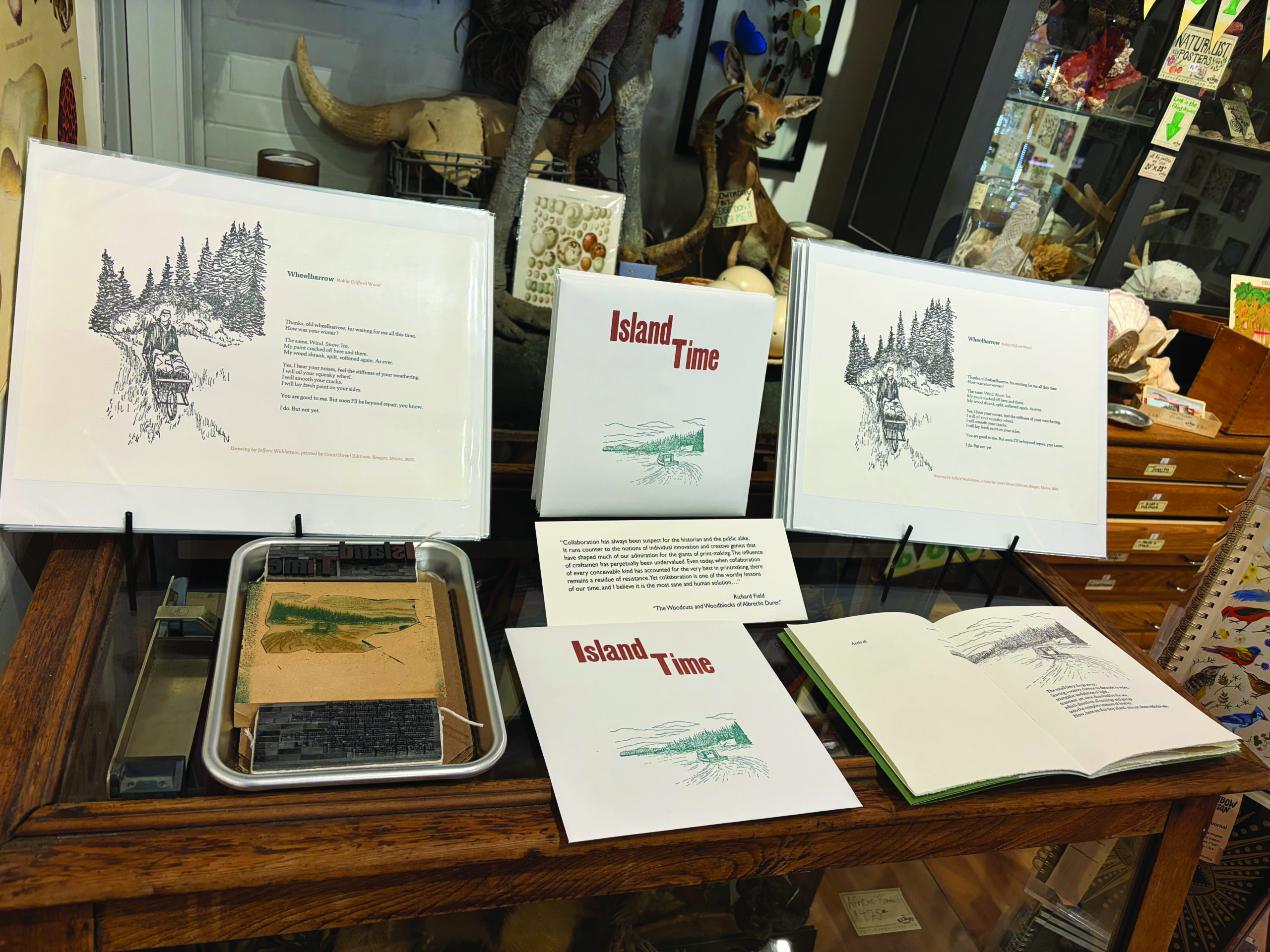
Commercial production has made books as commonplace as paper napkins, and often as disposable. For Walter, a book is a marvel that deserves the same meticulous attention as any work of art. He explored paper options, choosing deckle-edged cream-colored paper for the pages and Tsumugi Japanese Linen paper for the cover. He decided on the pagination and the layout — only five poems for the book, plus one standalone broadside. He sent Jeff’s drawings off to a plate-maker. From his collection, he chose an old-fashioned Palatino typeface, then the ink colors. He set the type by hand — each letter, each space, each punctuation mark. He ran the typeset pages through the printing press in his studio and made prints of Jeff’s drawings by hand-rolling. With clothespins, he hung the printed sheets on strings to dry in his studio. Finally, he folded them just so, then took them on vacation so he could sew together the 120 copies while he was traveling.
It wasn’t until after our project was completed that I went online and read about Walter. One writer referred to him as “legendary book artist and printer, Walter Tisdale.” He studied book arts at University of Wisconsin and has since spent decades refining his skills with typography, book forms, and collaborations with other artists. He spends hours puttering around his studio, experimenting, designing, creating, and practicing an art that’s little changed over the last 200 years.
Timelessness comes to mind when I think of the art Walter practices, and timelessness inspired the poems about island life, its winds and tides and imperceptible movements of geologic change. We decided to call our book “Island Time.”
Had I known about Walter’s “legendary” status from the start, I may have been more hesitant to ask him to make a book with us. I’m so glad we did. Being a writer or an artist is generally a solitary endeavor. A three-part collaboration elevated the process, reinforced a friendship, expanded my thinking, and was also a ton of fun.
Books can be a work of art, steeped in history, saturated in creativity and innovation. A book, it turns out, can be so much more than just something to read.