Grab a Paddle
Canoeing: A Peaceful Gateway to Maine’s Wild Places
By Jasmine Cabanaw
You may have heard the Maine folk saying, “You can’t get there from here.” This is only true if you haven’t been in a canoe. The history of canoeing in Maine dates back more than 5,000 years, when the Wabanaki nations used birchbark canoes to stealthily navigate narrow river passages and waterways. These easily repairable, lightweight canoes enabled Wabanaki people to traverse portage routes, allowing for efficient travel, trade, and early exploration.
By the late 1800s, canoeing had gained popularity with Europeans across the state. In fact, the world’s largest canoe manufacturer originated in Maine. Founded by the Gray family, Old Town Canoe Co. began in 1898, inspired by the birchbark canoes of the Penobscot Nation.
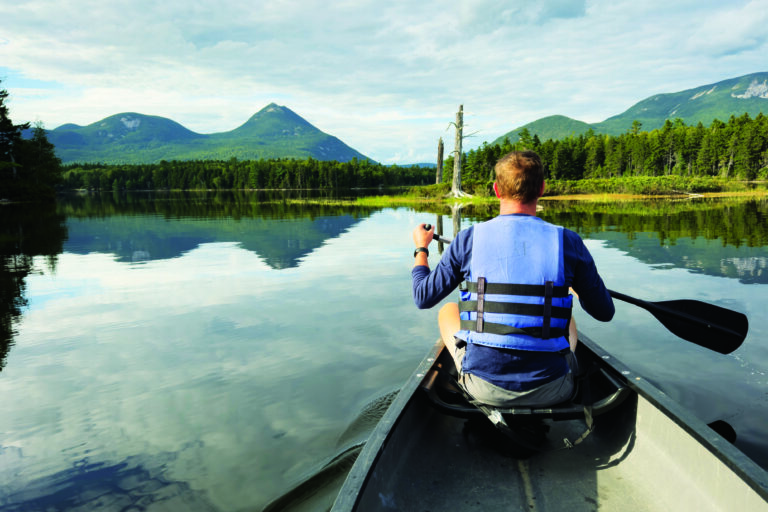
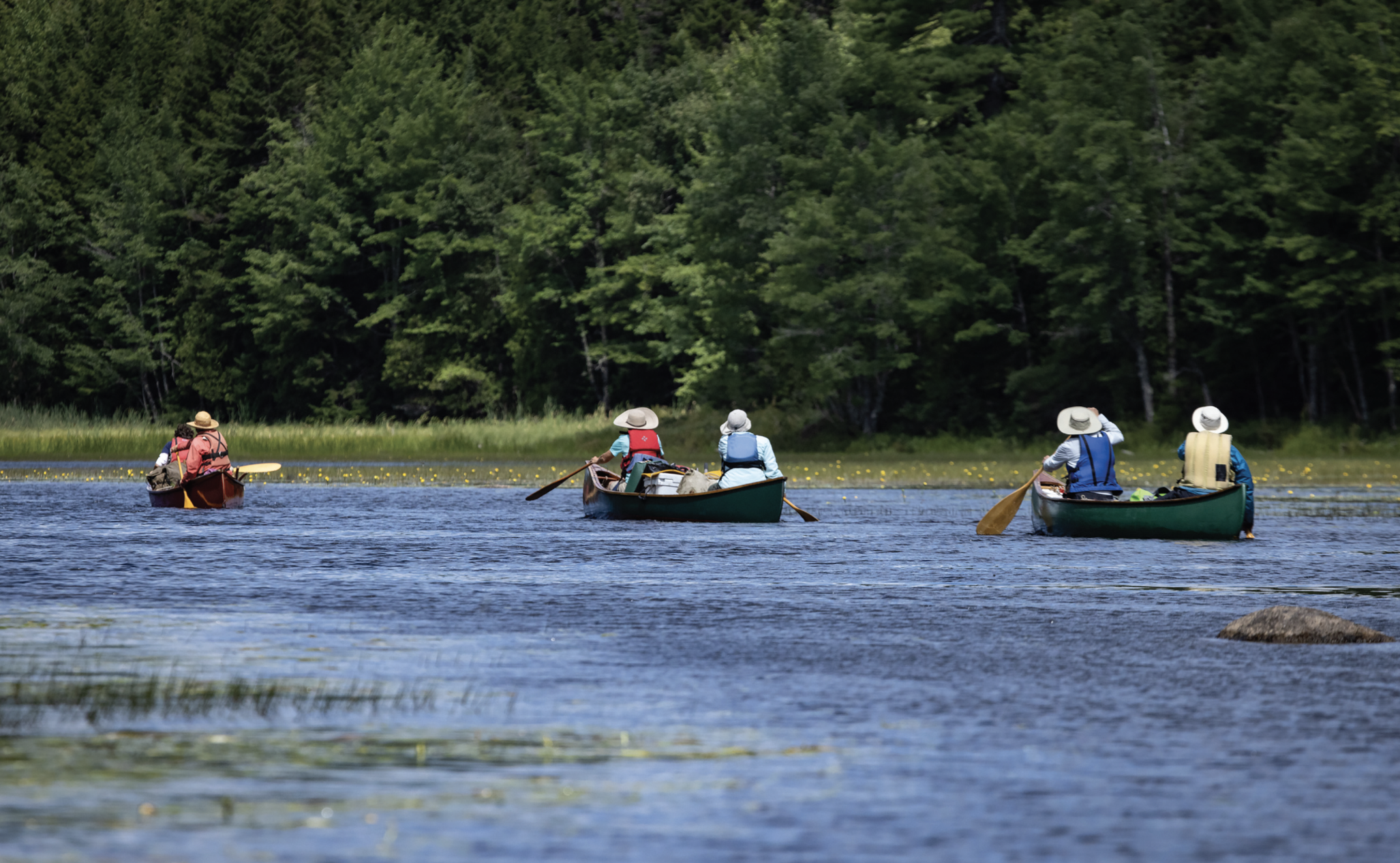
Today, canoeing is a favorite pastime for many Mainers. It’s also at the top of my list of the best ways to experience Maine’s nature. With more than 6,000 lakes and ponds, and more than 5,000 rivers and streams, canoeing allows me to see parts of the state that can otherwise be hard to reach.
Canoeing offers advantages that other modes of water transportation do not. Canoes can fit into spaces that are too small for most boats. Portaging enables the exploration of remote streams and ponds — spots that tend to be hidden from tourist crowds.
The simple quiet of canoeing has numerous benefits. The absence of noise from a boat motor means more wildlife stays nearby, which increases your odds of rare sightings, such as the fabled moose. The combination of this calm quiet and the concentration needed for paddling and maintaining balance also helps soothe the mind. It’s a wonderful way to reduce stress while enjoying nature.
Low-impact exercise is another benefit. Paddling strengthens the upper body and arms, and with each paddle stroke forward, the torso rotates and engages the core muscles. All of this is great for heart health, too, because it gently increases heart rate and improves circulation.
While kayaking offers many of these same benefits, one of my favorite aspects of canoeing is the social component. A good-sized canoe allows for afternoons spent on the water with friends. I love that we can pack a picnic, pile into a canoe, and have an entire pond to ourselves. Being in a canoe together also requires teamwork and focused communication — no one wants to be the person who causes the canoe to tip over.
Canoeing is for the masses. It’s cheaper than most other options. Used canoes can be found for as low as $50 on Facebook Marketplace, while new canoes start around $1,000. Canoe rentals are plentiful. In Baxter State Park, you can rent a canoe for as little as $1 an hour. Day rates for most places range from $15 to $30. This becomes even cheaper if you are sharing the canoe and can split the cost.
If you’re looking for something more adventurous, guided canoe trips are a great way to go deep into Maine’s forests and learn about Wabanaki culture. For instance, Mahoosuc Guide Service partners with guides from the Penobscot Nation for its four-day Way of the Wabanaki Cultural Canoe Trip, where participants learn about medicinal plants, birchbark canoe building, basket weaving, and more.
For a free canoe ride, try tapping into your community network. One of my favorite canoeing memories was the day I helped my friend’s daughter experience her first canoe ride. In this case, my partner and I were the canoe suppliers. When my friend asked if she and her daughter could join us on the Marsh River, of course we said yes. It was delightful to see her daughter transform from feeling anxious to having absolute joy dance across her face as she took in the water lilies, playful ducks, a beaver dam, and frogs peeping out from under lily pads.
If you’re new to canoeing, calm waters are the key to a good experience. Safety is a must, so wear those life jackets. Popular beginner-friendly spots include the slow-moving Saco River, Camden Harbor, Baxter State Park, and the West Branch of the Penobscot River.
My personal favorite is the section of the Marsh River that runs along the community park near my home in Brooks. Being on the water allows me to experience this beloved spot from a different perspective. I equally enjoy admiring the river from the park and admiring the park from the river.
What’s truly special about canoeing is that the canoe is both a way to get to a destination and a destination itself. Simply being on the water inside a canoe, no matter the location, can be enough to leave you feeling transported.