Maine Mottos
A Brief History of Dirigo and Vacationland
By Richard Shaw
Some days, it seems you can’t go anywhere in Maine without seeing two familiar names: Dirigo and Vacationland. In their own strange way, they go together like blueberries and whipped cream.
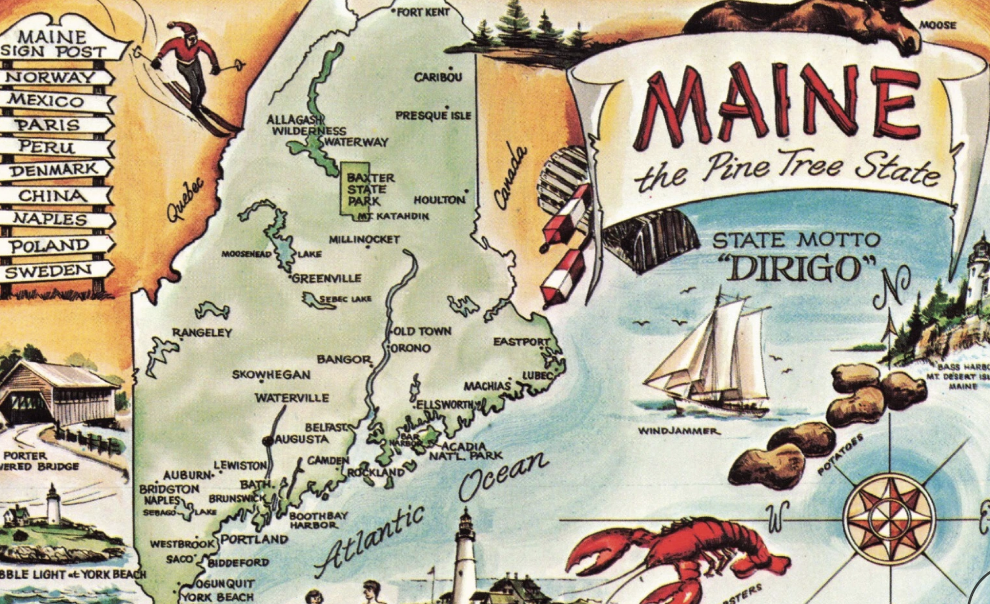
The former, the state’s official motto since 1820, appears on the state seal and has inspired school names, roadways, and even a brewery. The latter, the unofficial Pine Tree State slogan, has appeared on license plates since 1936.
How did a three-syllable Latin word some people couldn’t pronounce, and a rambling nickname perhaps better suited for sunny Florida than the Pine Tree State, become part of Maine culture? Conflicting accounts lie in books, newspaper articles, and with local historians.
“Dirigo means ‘I lead,’” explained State Archivist Christian Cotz, “and is indicative of the independence and individualism Mainers appreciate and are known for. It also references our geographic location as the state farthest east (and once farthest north), and our trend-setting nature.”
Maine’s state seal, depicting a farmer, a fisherman, a pine tree, a moose, and a star, has been tweaked over the past 206 years, but the words Dirigo and Maine have changed little. Benjamin Vaughan, a British intellectual and political radical who settled in Hallowell in 1797, designed the seal. He also favored republican government but opposed statehood in 1820.
Vaughan’s love of Latin was apparent in his choice of Dirigo, pronounced DEER-ih-go, not deer-EYE-go. Cotz explained this name proved accurate when the state’s presidential race results from September often predicted who would win national elections. The saying, “As Maine goes, so goes the nation,” reaffirmed the state’s motto, which also translates to “I direct.”
Fast forward to the Great Depression, when Maine legislators and publicists were casting about for a slogan that would lift people’s spirits and boost tourism beyond the word Dirigo. Thank — or possibly blame — state Rep. Frank MacKenzie of Jackman, a member of the House’s Publicity Committee, for proposing a bill to place Vacationland on plates.
“That word was always on our license plates from when I was a kid to the present time,” said David Bergquist, a historian and classic car enthusiast. “I had a 1914 license plate, and the motto was not on it. This was probably promoted by the Chamber of Commerce in the 1930s, when auto travel became more common.”
Peter Dow Bachelder’s book “Vacationland: A History of the Maine Tourism Industry” explores the origin of the word “Vacationland,” including how it first appeared in a 1923 Maine Publicity Bureau travel guide and later ended up on license plates.
“Despite the favorable outcome for the bill’s supporters,” Bachelder writes, “the few who had opposed its passage weren’t totally willing to give up on having it repealed. The following year, Sen. Marion Martin of Hallowell submitted a measure that would remove Vacationland from all Maine license plates, although the House Publicity Committee reported unfavorably on it, effectively ending its chances for further consideration.”
It appears that Vacationland is here to stay, despite failed legislation in 2019 to change it to Staycationland and, later, to Dirigo. At times, a slogan some people don’t like, such as New Hampshire’s “Live Free or Die,” can still be better than the alternative slogans being proposed.
The next time you visit Dixfield’s Dirigo High School, Dirigo Pines Assisted Living in Orono, or notice Vacationland sprawled across Maine’s new pine tree license plates, credit the bold souls of past centuries who made it happen. They might be surprised to see those names flourishing into the 21st century.